A working definition
What are movement studies?
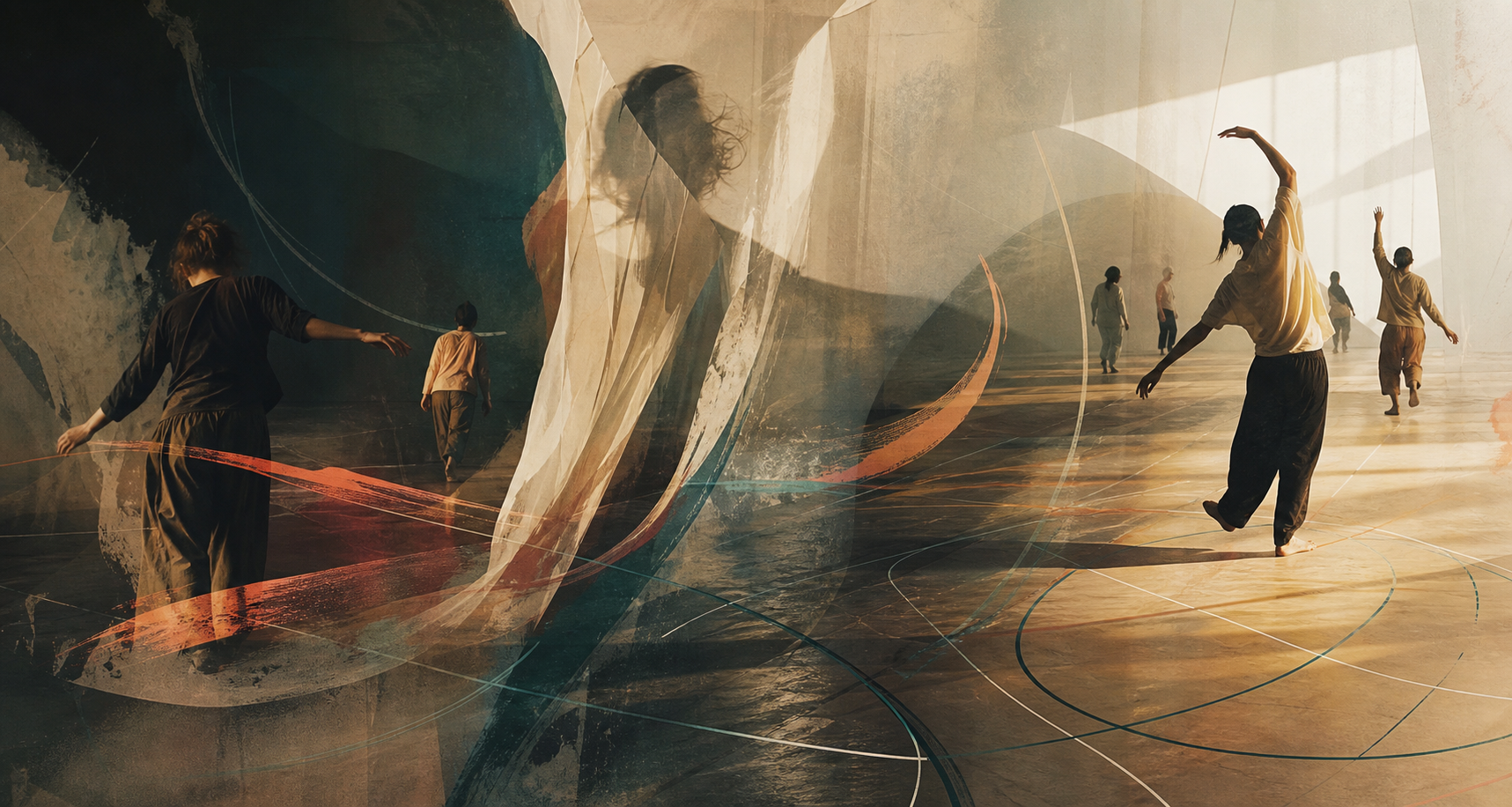
Movement studies is an interdisciplinary way of investigating movement as physical action, lived experience, artistic material, cultural practice, and a source of knowledge.
The phrase changes meaning with context. In one setting it may refer to experimental human movement science. In another, it may mean Laban/Bartenieff Movement Studies, somatic education, dance scholarship, or artistic research. In social science, “social movement studies” concerns collective action and political or cultural change—not primarily bodily movement.
At Movement Studies Academy, we use the lowercase phrase as an educational frame for studying how movement is sensed, learned, created, transmitted, and situated. That is MSA’s institutional usage, not a claim to own or standardize the wider field.
Good movement study begins by naming its context. A biomechanics experiment, a somatic lesson, a choreographic score, a martial practice, and an oral history may all generate insight, but they ask different questions and require different forms of expertise.
Field map
One phrase, several distinct contexts.
The boundaries are porous, but the distinctions matter. Each context below has its own questions, methods, standards, and communities.
Human movement sciences
- Focus
- How people move, adapt, learn, perform, and sometimes lose or regain movement capacity.
- Common methods
- Experimental and applied research drawing on biomechanics, physiology, motor control, psychology, sport, and health.
- Keep in view
- Often based in universities and laboratories. It is not the same thing as somatic education or artistic research, although projects can overlap.
Laban/Bartenieff Movement Studies
- Focus
- A specific field built from the movement systems and inquiries of Rudolf Laban and Irmgard Bartenieff.
- Common methods
- Observation, sensing, moving, analysis, notation, and attention to Body, Effort, Space, and Shape.
- Keep in view
- LBMS is a named field with its own history, institutions, vocabulary, and professional formations. It should not be used as a generic label for every kind of movement study.
Somatic movement education
- Focus
- The moving body as it is sensed from within, including attention, perception, habitual patterns, and new possibilities for action.
- Common methods
- Experiential anatomy, guided attention, movement exploration, verbal guidance, and—within some trained practices—consensual touch.
- Keep in view
- Somatic methods are diverse and carry different lineages and scopes. Educational practice should not be presented as medical diagnosis or treatment.
Dance, performance, and artistic research
- Focus
- Movement as artistic material, research method, cultural practice, and a way of producing and sharing knowledge.
- Common methods
- Studio practice, improvisation, choreography, scores, documentation, critical reflection, performance, and other practice-led forms.
- Keep in view
- The artistic process may be both the means of inquiry and part of its result. Its outputs do not have to resemble a laboratory study or conventional academic paper.
Practice traditions and embodied education
- Focus
- How knowledge is developed and transmitted within martial arts, yoga, physical preparation, contemplative practices, voice work, and other living traditions.
- Common methods
- Direct practice, apprenticeship, pedagogy, historical study, cross-cultural dialogue, and careful attention to lineage and context.
- Keep in view
- These traditions should not be flattened into one generic system. Their own names, communities, purposes, and disagreements matter.
Social movement studies
- Focus
- Collective action, protest, organizing, political change, cultural movements, and the networks that sustain them.
- Common methods
- Social-scientific, historical, political, cultural, and interdisciplinary research.
- Keep in view
- This is a different meaning of the phrase. Here, movement means organized social or political action rather than primarily bodily movement.
Ways of knowing
How can movement be studied?
No single method answers every movement question. Strong inquiry matches the method to the question and makes its limits visible.
Measure and model
Researchers may record force, timing, coordination, physiology, perception, or performance and analyse patterns across observations.
Observe and interpret
Close description, interviews, ethnography, video, notation, and cultural analysis can show how movement acquires meaning in context.
Sense and practise
First-person attention and repeated practice can investigate how action, perception, habit, choice, and environment meet in lived experience.
Create and document
Artists may use improvisation, composition, scores, performance, writing, and media to test questions through practice and share what emerges.
Trace histories and lineages
Archives, oral histories, source texts, and relationships between teachers and communities help locate a practice without claiming a single uncontested story.
Teach and reflect
Pedagogical inquiry studies how learning conditions, language, consent, feedback, access, and group relationships shape what becomes possible.
Interdisciplinary does not mean interchangeable. Combining methods is useful when the people involved understand their different assumptions, evidence, scopes, and ethical responsibilities.
Choosing a path
Start with the question, not the label.
A course or institution may use familiar words while offering a very different kind of study. Before enrolling, ask what you will actually do, who will guide it, and what claims are being made.
What is the main object of study: physical performance, perception, artistic practice, a named method, cultural meaning, or collective action?
Will you mostly work in a laboratory, studio, classroom, archive, community setting, or several of these?
What formation, lineage, research experience, or teaching practice supports the people leading the work?
Are the scope and claims clear—especially where education, therapy, health, professional credentials, or cultural authority might be confused?
How are consent, pacing, accessibility, feedback, attribution, and the option not to participate handled?
What will you be able to practise, understand, create, research, or continue studying afterward?
MSA’s approach
A meeting place, not a universal method.
Movement Studies Academy brings distinct movement practices into a shared learning environment while preserving their names, histories, and differences. We currently work across somatic education, dance and improvisation, martial arts, yoga, physical preparation, breath and voice, partnering, and creative research.
MSA does not present these practices as one synthesis, and it does not treat “movement studies” as a universal credential. Faculty are selected for depth of practice, relevant formation or lineage, teaching ability, and ethical conduct. Programs should state their scope and avoid turning educational work into unqualified medical, therapeutic, or professional claims.
Our role is to help learners orient themselves: to understand what a practice asks, where it comes from, how it relates to other fields, and whether its learning conditions fit their needs. Explore the modality map, read our educational philosophy, and see how we approach lineages and living histories.
Sources & limits
A guide designed to remain correctable.
This page is an editorial orientation, not a settled definition for every institution or community. It draws on the following institutional sources, reviewed on 31 August 2026. MSA welcomes corrections and additional perspectives.
- Laban/Bartenieff Institute of Movement Studies — LIMS Research
The institute’s description of LBMS research, its systems, and its methods.
- International Somatic Movement Education and Therapy Association — Pillars of the Profession
Professional scope, methods, competencies, and boundaries in somatic movement education and therapy.
- Vrije Universiteit Amsterdam — Research Human Movement Sciences
An academic account of experimental, multidisciplinary human movement research.
- Society for Artistic Research — About SAR
Artistic research as a distinctive form of knowledge production within and beyond academic settings.
- Social Movement Studies — Aims and scope
The social-science meaning: research on political, cultural, and social movements, protest, and supporting networks.
Editorial status: Movement Studies Academy editorial guide. It does not represent the cited organizations, and their inclusion does not imply endorsement of MSA. To suggest a correction, email the editorial team.